

Preparation: Around 24-36 hours (depending on season)
Cooking: 20 + 10 + 20 minutes.
Ingredients:
Levin:
- 2 tsp starter (sour dough culture)
- 2 tbls EVO (extra virgin olive oil)
- a few big heaped tbls white flour
- a little water to make a creamy paste
Main dough (for large cast iron pans):
- 1 tsp salt (dissolved in..)
- 475ml tepid water
- 650g white stoneground flour
Method
Part 1:
(around 4-6 hours)
- Place the levin ingredients in a large mixing bowl and blend well with a silicone spatula or similar. You should get a sloppy / thick cream type mixture.
- Leave this to sit for around 4-6 hours at room temperature, mixing occasionally if you feel so inclined. It should be happy and have some big bubbles in it. If not, leave it to sit a while longer, and/or move it to a warmer place.
Part 2:
(around 18 – 24 hours)
- Dissolve the salt in the tepid water, and add the liquid to the levin. Mix well.
- Add the flour to the watery mix, and mix well. That’s the hard part done.
- Note: This will be a much wetter dough than you would otherwise imagine. There’s no kneading required.
- Cover the dough, and leave to stand for around 18 – 30 hours at room temperature. If it’s warm, leave it for less time. If the room is colder, leave it for longer. If you do this stage for around 36 hours you’ll get an even richer dough (when breaking the full rise a few times).
- During this stage, roughly midway at around 8-10 hours or so when it’s doubled in size for the first time (ie after an overnight, or after much of the daytime), fold the mix into itself gently once around the bowl. Don’t over-mix. Ideally repeat this a few times with around 30-60 minutes apart between each mix/folding. But don’t over-mix here either. You’re just stretching the gluten strands by briefly folding it in to itself.
- Leave it the remaining 3-6 hours from here (or overnight if it’s a cool night). it’s likely to double in volume again during this time (if not, leave it for longer).
Part 3:
(around 60 – 80 minutes)
- Preheat your oven to around 250 degrees Celsius, with a heavy cast iron Dutch oven, or similar inside the oven pre-heating too.
- Carefully bring out the very hot cast iron pans and place on heat protected worktop / hob. Place the lid to the side. And ‘pour’ in the stretchy sour dough mix (encouraging it with a wet silicone spatula), into the hot pan. Don’t worry about scoring the top with a knife of similar, it finds it’s own level.
- Cook for 20 minutes at 250 degrees C, with the lid on, in the middle of the hot oven.
- Cook for 10 minutes more at 200 degrees C, keeping the lid on.
- Cook for 20 minutes more at around 200 degrees C, but this time with the partially baked loaf carefully removed from the pan entirely, and placed directly onto the wire oven rack.
- Remove from the oven (it’ll look just a little burnt in places). Leave it to stand on a cooling rack for at least 30-60 minutes, before even attempting to cut into it with a breadknife.
- The crust is extra crusty for the first few hours. This crust will soften a little overnight as the interior also dries a little.
- Slice off as many slices as you want. Store the rest in a cotton bread bag / wooden bread bin. It should be good for about 2-3 days, but of course will be best for the first 24 hours, and then better for toasting thick slices further down the line.
Alternative for large loaf tin:
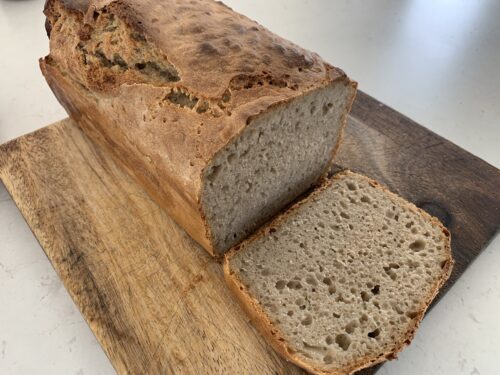
Loaf tin ingredients:
- 1 tsp salt (dissolved in..)
- 400ml tepid water
- 520g white stoneground flour
Loaf tin cooking:
- Preheat the oven to 220 degrees C.
- Whilst the oven pre-heats, remove the loaf tin at around 100-150 degrees,
- Add the raw dough to the hot loaf tin (as above), whilst the oven continues to heat to full temperature.
- Cook the loaf in the pan for 40 minutes at 220oC.
- Remove loaf from the oven and the tin, and allow to cool for around 30 minutes before slicing.
Notes:
The above methods are my latest personal iterations, based on my previous far more complex attempts sour dough version 1 (2018) and sour dough version 2
I keep the starter in the fridge all the time now, only feeding the equivalent of what I take our every 4-5 days, which is typically how long it takes to make the next loaf.
I’ve also found it’s significantly easier and more consistent to make loaves of bread living in a house at a more constant temperature and humidity, than when living on a boat on the sea!
Leave a Reply